
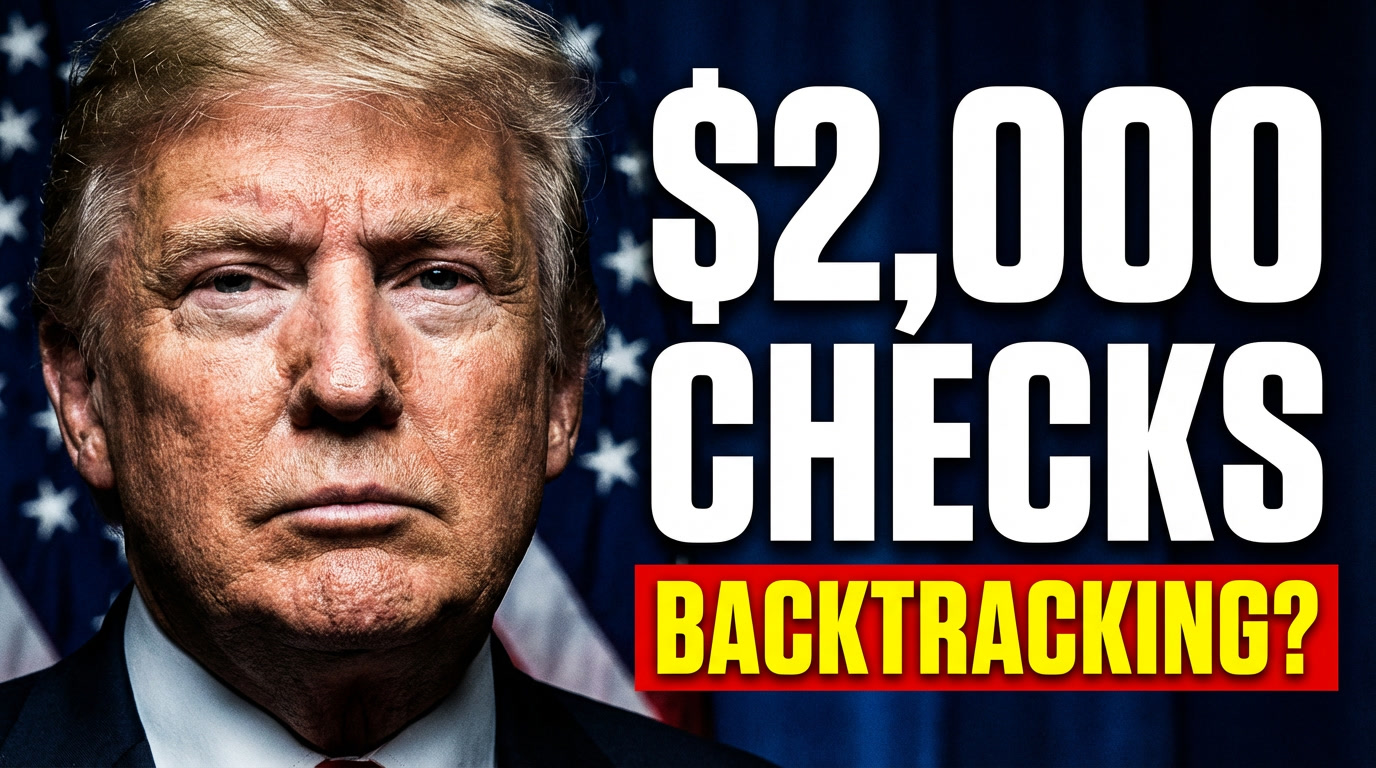
For a moment, it sounded like a political slip you couldn’t script better. Former President Donald Trump, pressed on a campaign promise he once touted loudly—$2,000 stimulus-style checks funded by tariff revenues—appeared genuinely confused.
“I did do that? When did I do that?” he asked, cutting off the question mid-sentence.
The clip, now circulating widely online, has reopened a debate many voters thought was settled: was the so-called “tariff dividend” ever a real policy plan, or just another economic talking point that faded once the cameras moved on?
The Original $2,000 Tariff Check Promise
Trump first floated the idea in late 2025, framing it as a bold extension of his protectionist trade agenda. The logic, as he presented it, was straightforward: if tariffs on imports were generating billions in revenue, why not send some of that money directly back to American households?
He described the proposal as a $2,000 payment to qualifying Americans, funded entirely by tariff collections. No borrowing. No deficit spending. Just redistribution of trade revenues.

At rallies and interviews, Trump pitched it as a “win-win”—punish foreign competitors, reward U.S. consumers, and even chip away at the national debt. It fit neatly into his “America First” narrative and echoed the language of pandemic-era stimulus without calling it that.
At the time, the claim drew skepticism from economists, but it stuck with parts of the electorate.
The Interview That Sparked the Backlash
That promise resurfaced during a recent interview conducted by Tyler Pager and Katie Rogers, later posted on X (formerly Twitter). Rogers began asking Trump about the $2,000 checks and their timeline.

Before she could finish, Trump interrupted.
“I did do that? When did I do that?”
The exchange immediately raised eyebrows. Critics seized on it as evidence that Trump was either backtracking or had simply forgotten a central economic pledge. Supporters argued it was a misunderstanding or poor phrasing, amplified unfairly by social media.
Either way, the moment landed awkwardly—especially given how prominently the idea had been discussed just months earlier.
What Trump’s Advisers Previously Said
The confusion stands in contrast to earlier statements from Trump’s own economic team.
In early 2026, Kevin Hassett, Trump’s top economic adviser, spoke openly about the proposal during a televised interview with CBS News’ Margaret Brennan.
“I would expect in the new year the president will bring forth a proposal to Congress to make the $2,000 checks a reality,” Hassett said.
He also acknowledged a key limitation often glossed over in campaign rhetoric: tariff revenue, like all federal revenue, can’t be spent without Congress.
“This would have to be money that’s an appropriation,” Hassett explained. “We get revenue from lots of places.”
In other words, even if tariffs generated surplus funds, distributing them would still require legislation—something far from guaranteed in a divided Congress.
Trump’s Pivot to the $1,776 Military Payment
As the interview continued, Trump appeared to pivot away from the $2,000 checks entirely, instead pointing to a $1,776 payment that went to military service members.
“Well, I did $1,776 for the military,” Trump said, suggesting it functioned as a kind of “war dividend” funded by tariffs.
That claim didn’t hold up.
According to Thomas Novelly, a senior military reporter who reviewed the funding source, the payments came from Congress-approved reconciliation funds, specifically allocated to boost housing allowances for service members. The money did not originate from tariff revenues.
The Department of Defense routinely details such allocations through official releases at https://www.defense.gov/, and the funding trail is clear: Congress, not tariffs, paid for those checks.
Is the $2,000 Check Still Alive?
Despite the apparent confusion, Trump didn’t fully bury the idea.
Pressed again, he suggested the checks could still happen.
“Well, I am going to—the tariff money is so substantial that’s coming in, that I’ll be able to do $2,000 sometime, I would say toward the end of the year.”
That statement offered no details. No eligibility rules. No distribution mechanism. No draft legislation. No confirmation of congressional support.
At this stage, the promise appears more aspirational than operational—a familiar pattern in campaign economics.
The Legal and Political Reality
Here’s the part often missing from campaign sound bites.
Tariff revenues flow into the U.S. Treasury, just like income taxes and corporate taxes. From there, spending is governed by the federal budget process. That process requires congressional authorization and appropriation, as outlined by the Treasury Department at https://home.treasury.gov/.
Even with supportive lawmakers, redistributing tariff revenue as direct payments would face major hurdles:
• Congress would need to pass an appropriation bill
• Lawmakers would need to agree the revenue exists in surplus
• Legal challenges could arise over earmarking trade revenues
Many economists also argue that tariffs are largely paid by U.S. consumers through higher prices, meaning the “revenue windfall” is offset elsewhere in the economy.
The Congressional Budget Office has repeatedly noted that tariffs tend to redistribute costs, not create free cash.
Public Reaction: Skepticism vs. Loyalty
Reaction online has been swift and divided.
Critics say the interview confirms what they suspected all along—that the tariff dividend was rhetorical, not realistic. Supporters counter that Trump was speaking off the cuff and that the broader idea remains viable if he regains power and aligns Congress.
For now, voters are left with uncertainty. A promise once framed as imminent now seems conditional, delayed, and loosely defined.
Whether it resurfaces as a concrete policy or fades into the archive of unrealized campaign pledges will depend less on sound bites—and more on legislation that hasn’t yet appeared.
FAQs:
Did Trump really promise $2,000 checks funded by tariffs?
Yes. He publicly discussed the idea in late 2025 as part of his economic agenda.
Has Congress approved any such payments?
No. No formal proposal or appropriation bill has been introduced.
Were the $1,776 military checks funded by tariffs?
No. They were funded by congressionally approved reconciliation funds.